
Why Your Habits Keep Failing (And It's Got Nothing To Do With Discipline)
You know the feeling.
Sunday evening, or the morning after a holiday, or just some random Tuesday when something shifts and you decide — this time is different. You've got the plan. You've thought it through. Maybe you've bought something: the trainers, the journal, the app. There's that clean, almost electric sense of possibility that a fresh start brings.
Monday arrives. You execute. Tuesday too. For a week or two, you are the person you decided to be.
And then, quietly, it starts to slip.
Not dramatically. There's no single moment of failure. Just a morning where the alarm goes off and you turn it over. A week where the routine drops and somehow never quite restarts. The old patterns drifting back — almost apologetically, like they'd only ever stepped outside for a moment.
Which, of course, they had.
I want to be clear about something: that collapse wasn't weakness. It wasn't lack of effort. And it certainly wasn't proof that you're someone who can't change. It happened because almost everything we've been taught about building new habits has the sequence back to front.
The thing nobody tells you
The standard approach goes like this — decide what you want, build habits around that goal, repeat until they stick.
Clean. Logical. And it misses the most important thing entirely.
Your habits aren't just actions. They're expressions of who you believe yourself to be.
I was speaking to one of the men I work with recently who'd been trying for months to make exercise stick. He'd tried every approach — gym memberships, morning alarms, accountability apps. It would work for a while, then quietly fall apart. When we got into it, what became clear wasn't that he lacked discipline. It was that he'd never actually seen himself as someone who does that. Every attempt started with the behaviour. None of them started with the identity.
That's the bit that's missing for most men.
James Clear explores this in Atomic Habits — the idea that lasting change doesn't happen at the level of outcomes or even systems, but at the level of identity. Not what do I want to achieve but who am I becoming. Research on self-concept consistency supports this too — behaviour is measurably more stable when it aligns with how we see ourselves. One study found that simply reframing habits around identity rather than outcome increased adherence by 32%.
Same habits. Different story about who's doing them. Completely different results.
What the brain is actually doing
There's a neurological reason why this works — and why the opposite keeps failing.
Habits are stored in the basal ganglia, deep brain structures involved in automatic behaviour. When an action gets repeated consistently enough in familiar contexts, the brain eventually hands it off from the slow, deliberate prefrontal cortex — the part doing the conscious effort and the willpower — to this faster, almost effortless system. At that point, you don't really decide to do the thing. You just do it.
But — and this matters — the brain only makes that transfer for behaviour it recognises as yours. It needs the action to feel consistent with your existing identity before it files it away as automatic. Which is why so many habit attempts collapse halfway through. The brain treats the new behaviour as foreign. There's nothing for it to stick to.
Motivation compounds this problem. BJ Fogg, a behaviour scientist at Stanford, spent years on this. His conclusion was that the people who change successfully aren't the ones with the most motivation — they're the ones whose approach still works when motivation is low. And the most effective way to make a behaviour work when you don't feel like it? Make it feel like the natural expression of who you already are.
When a behaviour is anchored in identity, the resistance quietly drops. The brain stops pulling you back toward the familiar. It starts encoding the new pattern as normal.
Why this hits differently if you're a high-achieving man
If you're reading this, you've probably built a successful life through intelligence, effort, and an ability to set targets and close them out. That skillset works brilliantly in professional contexts.
It often quietly works against you when the thing you're trying to change is yourself.
High-achieving men tend to be outcome-focused by default. We set goals. Track progress. Optimise. We apply the same framework to personal development that we use at work — and then wonder why the results don't stick the way they do in the boardroom.
But you are not a project. You are not a KPI.
What I see, again and again, is a recognisable pattern. Intense early effort. A period of apparent success. Then a quiet reversion to baseline. The goal gets hit — or not — and either way the identity hasn't shifted. So the next time something needs to change, the starting point is exactly where it always was.
The men who break out of that cycle don't do it by trying harder. They do it by getting honest about a more fundamental question: who actually am I right now — and who do I actually need to become?
What it looks like when it actually works
I want to make this concrete, because "work on your identity" is the kind of advice that sounds meaningful and lands as useless.
It starts with getting specific — not vague and aspirational, but genuinely specific — about the next version of you. Not the finished version. Not the perfect one. Just the next one. What does he do in the morning? How does he respond when things get difficult? What does he protect, and what has he stopped tolerating? What does he no longer need external validation for?
The more specific that picture, the more useful it becomes. "I want to be healthier" has no edges. It can't guide a decision on a Thursday morning when you're tired and the meeting ran late. "I'm someone who looks after his body as a non-negotiable — not because I'm trying to look a certain way, but because it's how I respect myself" — that has edges. That can actually tell you what to do.
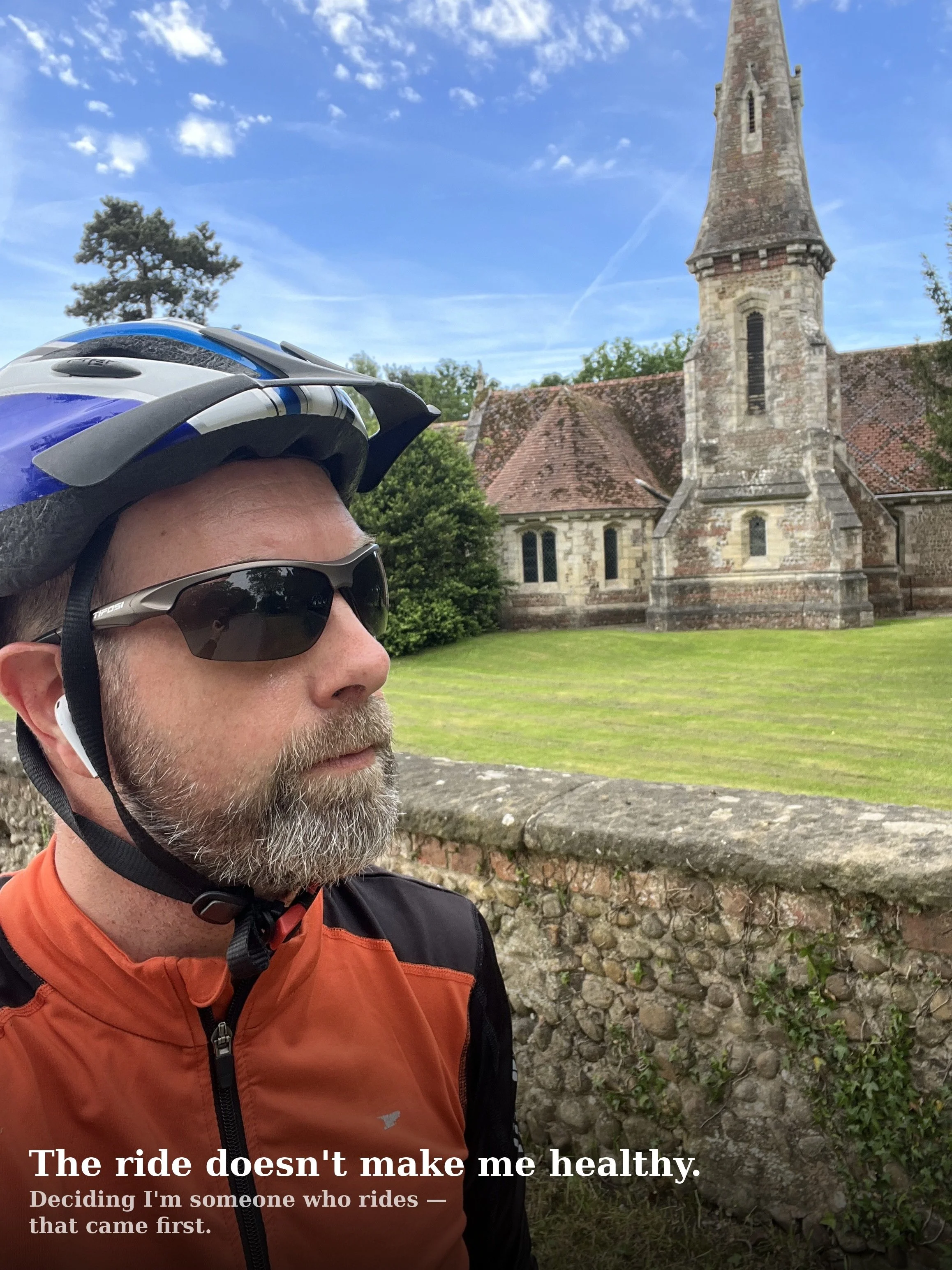
Classic case of identity first!
From there, the actions need to point directly at that identity. Start smaller than feels worth it. Fogg's research found consistently that tiny, almost embarrassingly easy actions build more lasting change than ambitious ones — not because they achieve more, but because they create evidence. Every time you do the thing, even the small version of it, you're telling your brain: this is who I am now. You're casting a vote for the new identity. Over time — and this compounds faster than most people expect — the brain starts to believe it.
And here's something that surprises most of the men I work with: identity can shift quicker than we think. We tend to assume it's slow, foundational, years-in-the-making. Research on self-concept plasticity suggests otherwise — that even in adulthood, how we see ourselves can change meaningfully in response to consistent action. You don't have to wait to become a different person. You start acting like him — in small ways, repeatedly — and let the identity catch up.
The shift I watch for
There's a moment in my work with men that I've come to recognise. It's quiet, but it's unmistakable.
It's the moment they stop saying I'm trying to be more consistent and start saying this is just what I do now.
That's not a motivational statement. That's an identity statement. And once a man makes it — genuinely, not just to sound good — the effortful quality of the change largely dissolves. The behaviour has been absorbed. It belongs to him.
Getting there doesn't require a dramatic overhaul. It requires getting clear on who you're becoming, being honest about the gap between that man and the one currently in the room, and taking small, deliberate steps that close that distance — one piece of evidence at a time.
The habits aren't the destination.
They're the proof.
Three questions worth sitting with
Not a framework. Just an honest starting point.
1. Who is the next version of you — specifically, not vaguely? What does he do, how does he carry himself, what has he stopped putting up with?
2. Where is the gap between that man and the one currently operating? Not as a criticism. As an honest look. Where are you still running on an older version of yourself?
3. And what's the smallest action you could take today that would be consistent with who you're becoming? Not the most impressive one. The most aligned one.
The answers to those questions are where real change begins. Not a new system. Not more willpower.
Just a clearer picture of who you actually want to be — and the decision to start becoming him.
Russ Bignell works with high-achieving men who sense a gap between the life they've built and the one they actually want to be living. He's been that man himself — which is why he knows that more effort, more discipline, and more self-improvement content rarely closes it.
His work sits at the intersection of identity shift, behaviour change, and neuroscience — helping men understand not just what needs to change, but who they need to become for that change to last.
Russ works with men across the UK and internationally. The men he works with leave clearer on who they are, more deliberate in how they show up, and finally able to close the gap between the man they've been and the one they know they could be.