
What Makes a Good Father?
A few weeks ago, I asked my 20-year-old son a simple question.
"What makes a good father?"
He paused for a moment and thought about it.
"Security," he said.
That was his answer.
Not success. Not discipline. Not advice.
Security.
The more I thought about it, the more I realised he may have summed up fatherhood in a single word.
Like many fathers, I've spent years wondering whether I'm getting it right.
Am I spending enough time with my children?
Am I teaching them the right things?
Am I setting the right example?
Am I being too strict? Not strict enough?
Have they even listened to a word I've said?
If I'm honest, there have been plenty of times when I've felt they don't hear me at all. Times when I've thought my advice goes in one ear and out the other. Times when I've questioned whether any of the effort, worry and responsibility that comes with being a father is making a difference.
Then every now and again, something happens that stops you in your tracks.
For me, it was a birthday card from my daughter:
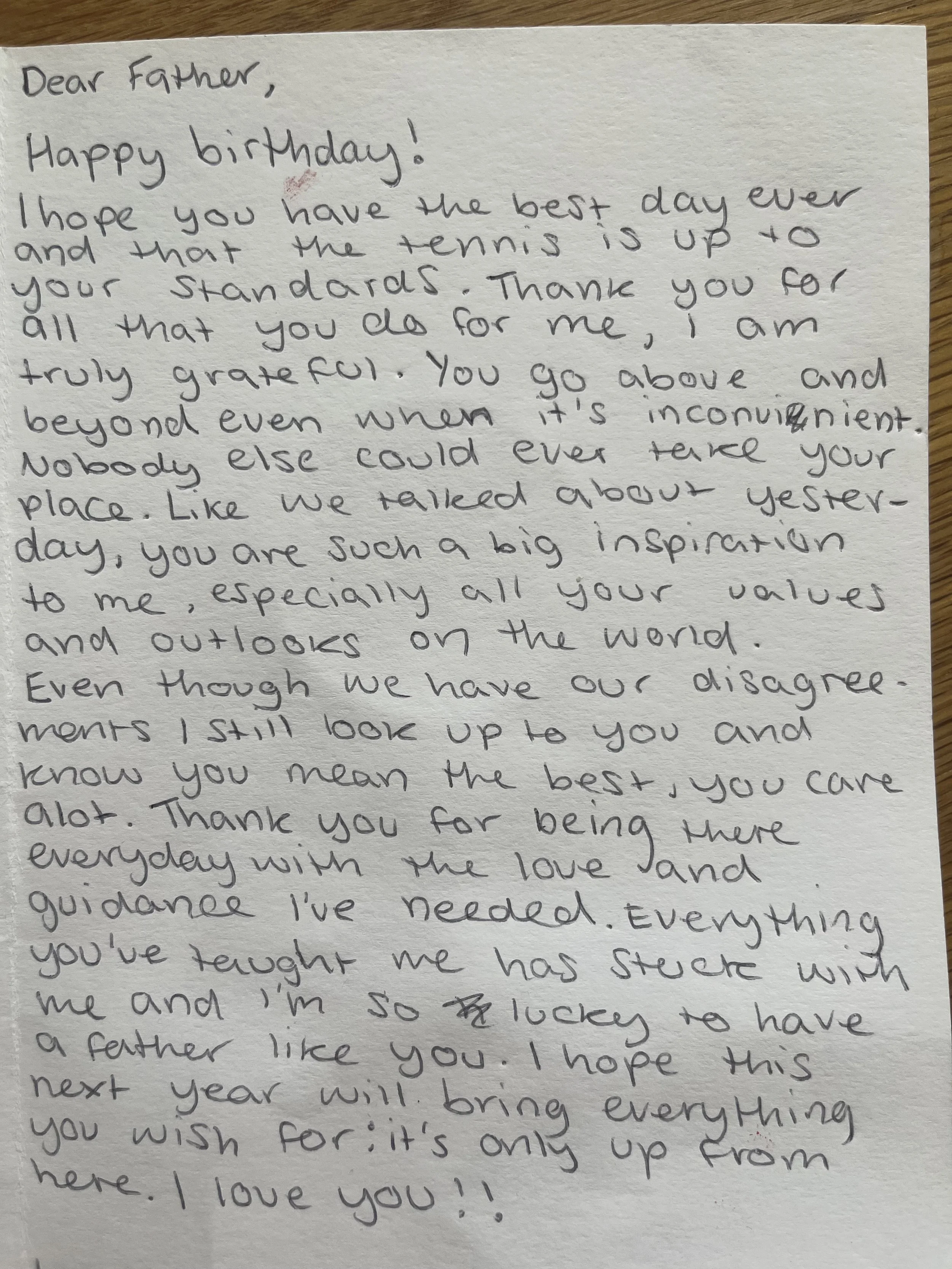
Cherished words about being a father
Inside, she wrote about the values and beliefs she had learned from me. She talked about learning that she doesn't have to follow a system simply because everyone else does. She spoke about independence, questioning things and finding her own path.
I was genuinely touched. Not because she was praising me, but because it made me realise something important. She had been listening.
Not necessarily to my words. To my example.
As parents, we often focus on what we say. Yet children seem to learn far more from who we are.
They watch how we treat people.
They notice how we respond when things go wrong.
They see how we handle pressure, disappointment and uncertainty.
They absorb our values long before they can articulate them.
And perhaps that's why fatherhood can sometimes feel so confusing. The impact isn't always visible.
When our children are young, we can see the direct effect we're having. We teach them to ride a bike. We help them with homework. We show them how to tie their shoelaces.
But as they get older, the lessons become less obvious.
You stop being the person with all the answers.
You become the person walking alongside them as they find their own.
That's certainly been my experience.
When my children were younger, I saw part of my role as providing, protecting, disciplining and encouraging. I introduced them to sport. I wanted them to be active, curious and confident. I wanted to create opportunities and experiences that would help them grow.
Today, my role feels different.
I spend less time telling them what to do and more time listening.
Less time giving answers and more time asking questions.
Less time trying to shape them and more time appreciating who they are becoming.
In many ways, I learn as much from them as they do from me. That seismic shift has taught me something else.
Many of the fathers I work with carry a quiet concern that they are somehow not doing enough.
They worry they're getting it wrong. They worry they should be spending more time, saying the right things, making fewer mistakes or being a better role model.
The irony is that when I look at these men from the outside, I rarely see failure.
I see fathers doing their best.
I see men who care deeply.
I see people who continue to show up, continue to learn and continue to try.
And perhaps that's the point.
Maybe children don't need perfect fathers.
Maybe they need present fathers. Not fathers who always know the answer. But fathers who are willing to listen. Not fathers who never make mistakes.
But fathers who take responsibility when they do. Not superheroes. Just human beings they can trust.
Looking back, I think my son was right. Security isn't just about providing financially. It's knowing there is someone in your corner.
Someone who believes in you.
Someone you can turn to when life gets difficult.
Someone whose love isn't conditional on success or failure.
Perhaps that is what a good father really is. Not a man who gets everything right. But a man whose children know they can always come back to him.
Most fathers spend years wondering whether they're enough.
Maybe the better question is whether we're showing up with the best intentions, learning as we go and remaining present in our children's lives.
If the answer is yes, then perhaps we're doing better than we think.
Perhaps that's enough.
Perhaps it always was.
Russ Bignell works with high-achieving men who sense a gap between the life they've built and the one they actually want to be living. He's been that man himself — which is why he knows that more effort, more discipline, and more self-improvement content rarely closes it.
His work sits at the intersection of identity shift, behaviour change, and neuroscience — helping men understand not just what needs to change, but who they need to become for that change to last.
Russ uses his Remapped Man concept to work with men across the UK and internationally. The men he works with leave clearer on who they are, more deliberate in how they show up, and finally able to close the gap between the man they've been and the one they know they could be.