
Bringing the Calm Back: Why Soothing Matters When You’re Always ‘On’
INTRO
For many high-achieving professionals, stress and burnout don’t arrive suddenly — they build quietly through an “always on” way of living. Constant pressure, overworking and never fully switching off keep the nervous system locked in threat and drive mode, making rest feel unsafe or unproductive. This article explores the neuroscience behind burnout and explains how activating the soothing system can calm the mind, regulate stress and create sustainable performance without sacrificing ambition.
MAIN ARTICLE
I used to be always ‘on’ – I know the feeling well. There was a time when my default mode was “full throttle”. Deadlines. Results. Always moving. Endless ‘doing’. If I’m honest I based my success on my productivity level. At work and at home. Whether it was producing more reports in double quick time in the office or ensuring the lawn was always in perfect condition. This list goes on….I never came up for air.
And the result of all this constant “on” state meant I didn’t just lose rest — I lost a sense of belonging to my own life and worst it impacted my family.
It took me far too long to figure out what was going on but eventually I did. And I now focus on sharing this with others when I can.
Threat, drive and soothing explained
What I came to realise is this: two systems in my brain were driving me relentlessly. The “go faster, get more, do more” system (we call this the Drive system) and the “watch out, something will go wrong” system (we call this the Threat system). They carry you far. Until they can’t. Until you hit burnout or breakdown.
But guess what, there’s a third system — the Soothing system — that kind of gets little airtime, yet it’s the one that restores, recharges and recalibrates. And for people who live in a constant on-mode, learning to activate that system is a game-changer.
A little bit of neuroscience
Research in the field of Three Systems Model by professor Paul Gilbert (also called the “Three Circles” model) explains how our emotions and motivators stem from three core systems: Threat, Drive, and Soothing. Balanced Minds+2Balanced Minds+2
The Threat System is about survival-mode: fight/flight/freeze, scanning for danger, anxiety, alertness. Psychology Tools+1
The Drive System is about striving, pushing forward, achieving. High energy, reward-seeking. Balanced Minds
The Soothing System is about rest, safety, connection, feeling calm. It uses different neurochemistry: oxytocin, endorphins, a sense of being held. Mindfulness & Clinical Psychology+1
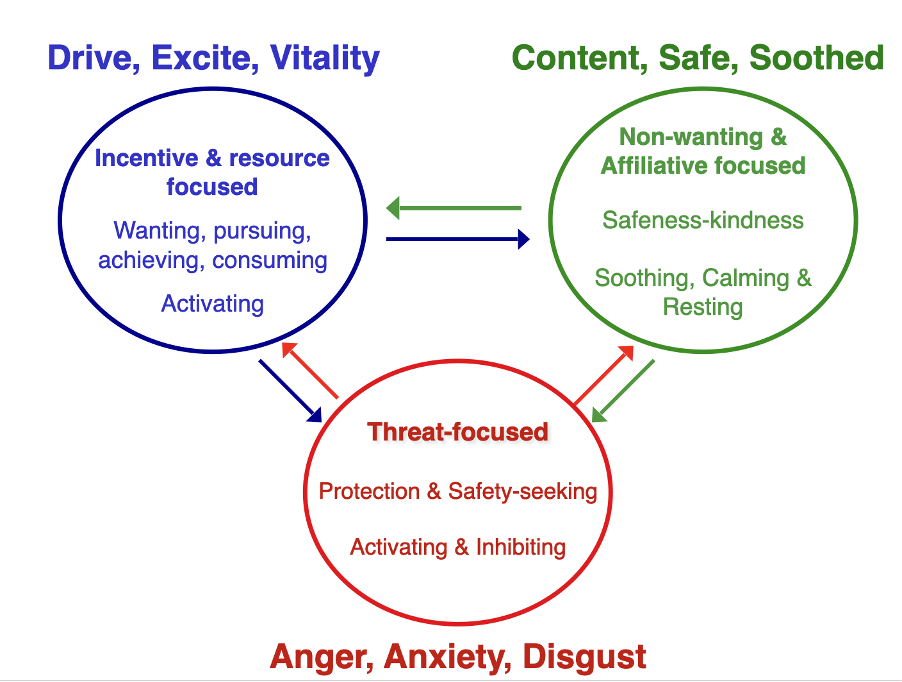
Three Systems Model by professor Paul Gilbert (also called the “Three Circles” model)
Here’s an analogy I like:
If your brain were a car, the Threat system is the emergency brake in a skid; the Drive system is the accelerator; the Soothing system is the cruise control and comfortable gear change. Without the soothing gear, you’re either braking or flooring it. Neither is sustainable.
If were in the “always on” phase, were ignoring the soothing gear. Were constantly in either brake or accelerator mode. The result? Symptoms like exhaustion, foggy head, poor sleep, stress…….the creeping feeling that something has to give — and eventually it did for me. I ended up with serious chronic illness due to the overload which I manage to this day. So it’s important to understand this stuff.
Why the Soothing System matters (especially when you’re stuck in Threat + Drive)
Basically because when you skip it, your brain pays a price.
When the Threat system is constantly activated (for example: “if I don’t do it all, I’ll fail”), the physiological load increases: high cortisol, elevated heart rate, the amygdala taking rule. The brain’s executive functions get sidelined. (Think: can’t think clearly, just react.) Leicestershire Eating Disorders
When the Drive system is dominant without rest, it leads to a “boom-and-bust” cycle: big push → crash → guilt or shame → repeat. Some studies of ADHD and procrastination show the cycle of threat → soothe → drive, and how neglecting soothing creates “stuckness”. Psychology Today
The Soothing system offers the regulation and recovery piece. By activating it, you give your nervous system and brain a chance to reset and build resilience. Research shows under-use of soothing links with self-criticism, shame, burnout. ppss-static.cumbria.nhs.uk+1
In other words: you can still be ambitious, still push. But if you never rest, never soothe, you’re only reducing your own capacity to sustain that pushing.
How I began to tap into the Soothing system
Because I’ve been there, I wanted to share a few practical insights I found useful. These are simple but powerful.
1. Recognise the throttle mode
Start by noticing when you’re in constant “go/alert” mode. For me it was that everything felt urgent, I couldn’t relax, I was always planning the next thing while still doing the current. Just noticing that was step one.
2. Pause the physiology
When I leaned into my soothing system, it began with simple physical cues: slow exhale, shoulders drop, realising I didn’t need to respond right away. That would be more doing! Neuro-science shows us our nervous system must calm a bit before we can access higher thinking (pre-frontal cortex) after the amygdala has taken over. thinkcbt.com
3. Create space and take kind, real-world actions
For me, a non-negotiable was/is “daily walk and these days a weekly dip in natural water” Nature + gentle movement helps to shift out of threat/drive.
Another: at the end of work week I schedule 24h where I cannot talk about work. It’s simple—but it gives the soothing system permission to show up. This can be hard to start but like all good habits is a needle mover.
4. Change the voice/narrative
When you’re constantly scanning threats (“what if it goes wrong?”) you trigger the Threat system. So start asking instead: “What if I slow down and still win?” “What if I rest and still produce quality?” The soothing system loves this kind of re-frame because it says: you are safe enough to pause. Active rest becomes a win which is a huge shift.
5. Mix in soothing with action
Soothing doesn’t mean you stop driving. It means you drive from a more regulated state. Instead of push-push-push, occasionally you drive consciously with full awareness, resting when needed, reconnecting when needed. It’s not about speed but endurance. Keeping sustained.
How to get started and something to try
Schedule a daily 10-minute walk without a screen, no agenda: sensing your body, how you breathe, what you hear. Slow deliberate walking (you will want to ‘get somewhere’ but focus hard on ‘mooching’ as I call it like you’re a kid again with no rush to get home!
During the day and especially just after a work session, immediately take 2 minutes of exhale-based breathing (count to 4 inhale, count to 6 exhale) to let your nervous system shift out of high alert. Breathwork is one of THE most valuable tools to change that state short term.
Write down one area where you usually go full throttle, and ask yourself: “What would a soothing approach look like here?” For instance: “If I met this deadline calmly and sustainably, what would change?”. Look at you diary and re-create it with time buffers for conscious self-care. Even 5 mins between tasks will help.
Why this matters for you
When you learn to invite the soothing system in, you build more than rest — you build resilience. You then can drive towards your goals not because you’re avoiding failure, but because you’re choosing action from a place of calm, clarity and meaning. You’re choosing you.
I went through the burnout, the illness, the dragging myself back to bed with a racing mind. I learned that skillset of “doing from fear” is not the same as “doing from choice.” And in coaching others, I see the same pattern over and over: high achievers stuck in the cycle, forgetting that rest is not optional—it’s an essential part of human performance. Use it don’t abuse it as I say!
If you feel like you’ve been living at full tilt for too long the soothing system isn’t a soft-option — it’s the smart option.
Russ Bignell